
Chemical Etching Company Guide to Avoiding Common Design Pitfalls in Photo Etching
Photo etching offers precision and versatility, but design pitfalls can compromise quality and increase costs. DRAGON ETCHING TECHNOLOGY., LIMITED (DRAGON ETCHING), a leader in chemical etching, provides this guide to help engineers and designers avoid these common mistakes. The article covers ten major pitfalls: ignoring etch factor in line/space geometry, which leads to dimension errors; sharp internal corners causing stress risers that can be mitigated with proper radii; overlooking material thickness effects on feature definition, requiring minimum feature sizes relative to thickness; inadequate hole and slot design for through-holes, with aspect ratio guidelines; inconsistent texture or marking depth, needing appropriate line width and depth; neglecting grain direction and material anisotropy, affecting uniformity; overlooking registration and multi-step etching tolerances; using inappropriate material selection that may not etch well; ignoring post-etching processes, requiring robust web widths; and insufficient design communication and lack of prototypes. Each pitfall is explained with practical solutions, and DRAGON ETCHING's capabilities—such as advanced simulation, precise phototools, and expert DFM review—are highlighted. The guide emphasizes early collaboration with DRAGON ETCHING to optimize designs for manufacturability, reduce rework, and ensure high-quality parts. By following these recommendations, clients can leverage the full benefits of photo etching while avoiding costly errors. DRAGON ETCHING's experience across multiple industries and its commitment to innovation make it an ideal partner for precision metal etching projects.
Photo etching, also known as chemical etching or photochemical machining, is a highly precise manufacturing process used to create complex metal parts. However, even with advanced technology, design mistakes can lead to costly rework, delays, and suboptimal performance. This guide, brought to you by DRAGON ETCHING TECHNOLOGY., LIMITED (DRAGON ETCHING), a leader in the chemical etching industry, outlines the most common design pitfalls and provides actionable advice to avoid them. By understanding these challenges, engineers and designers can fully leverage the benefits of photo etching—such as burr-free edges, tight tolerances, and rapid prototyping—while minimizing risks. DRAGON ETCHING, with its state-of-the-art facilities and years of expertise, has helped countless clients transform their designs into flawless metal components. Below, we explore the top pitfalls and how to steer clear of them.
Pitfall 1: Ignoring Etch Factor in Line and Space Geometry
One of the most frequent mistakes in photo etching design is failing to account for the etch factor—the ratio of undercut to etch depth. Chemical etching is an isotropic process, meaning it removes material equally in all directions. As a result, the etched feature will have a trapezoidal cross-section rather than a perfect rectangle. If the design assumes vertical sidewalls without compensation, critical dimensions may be too large (for holes) or too small (for islands). For example, a slot designed to be 0.5 mm wide might end up 0.6 mm wide after etching if the material is thick and the etch factor is high. To avoid this, designers should work closely with the etching provider to determine the correct compensation values. DRAGON ETCHING utilizes advanced etching simulation software to predict undercut and adjust tooling accordingly, ensuring that final parts meet tight tolerances. Best practice is to specify minimum feature sizes relative to material thickness—a common rule is that the minimum line or space should be at least 1.2 times the material thickness. Additionally, for critical dimensions, etching allowances should be explicitly noted on the drawing. DRAGON ETCHING's engineering team routinely reviews customer designs and suggests modifications to avoid such pitfalls, often before production begins.
undefined
Pitfall 2: Sharp Internal Corners Leading to Stress Risers
Sharp internal corners are a classic design pitfall in photo etching. Unlike laser cutting or stamping, chemical etching tends to produce a slightly rounded profile at corners due to isotropic etching. While this rounding is beneficial for stress distribution, designing extremely sharp internal angles (e.g., 90° corners) can lead to stress concentrations and potential cracking during use or subsequent forming operations. The photo etching process inherently rounds corners to some extent, but if the design demands a sharp corner, it may not be achievable without post-processing. To mitigate stress risers, designers should incorporate a minimum internal radius, typically at least 25-30% of the material thickness. For example, a part made from 0.5 mm thick stainless steel should have internal corners with a radius of 0.125 mm or larger. DRAGON ETCHING recommends using radiused corners wherever possible and can achieve radii as small as 0.05 mm with careful process control. In high-stress applications like medical devices or automotive springs, avoiding sharp corners is critical for fatigue life. The company's quality control includes stress analysis simulations to identify potential failure points. By partnering with DRAGON ETCHING early in the design phase, clients can optimize part geometry for both manufacturability and mechanical performance.
Pitfall 3: Overlooking Material Thickness Effects on Feature Definition
Material thickness significantly influences the achievable feature resolution in photo etching. Thicker materials require longer etching times, which increases undercut and reduces the aspect ratio of features. A common mistake is to design features that are too fine for the chosen thickness, leading to broken or malformed parts. For instance, a 0.1 mm wide slot in 1.0 mm thick copper may be impossible to etch cleanly because the undercut will merge from both sides, creating an oversized hole or complete removal. General guidelines suggest that the minimum hole diameter or slot width should be at least 1.5 times the material thickness for reliable results. For feature depth, the aspect ratio (depth to width) should not exceed 1:1 for most materials, though with optimized chemistry, DRAGON ETCHING can achieve up to 1.5:1. Designers must also consider that thicker materials will have a larger etch factor, requiring greater compensation. DRAGON ETCHING maintains a comprehensive database of etch factors for various metals and thicknesses, allowing precise design adjustments. The company's production team uses real-time monitoring to maintain uniformity across the sheet. To avoid costly revisions, always consult with DRAGON ETCHING's technical support before finalizing designs for thick or ultra-thin materials.
Pitfall 4: Inadequate Hole and Slot Design for Through-Holes
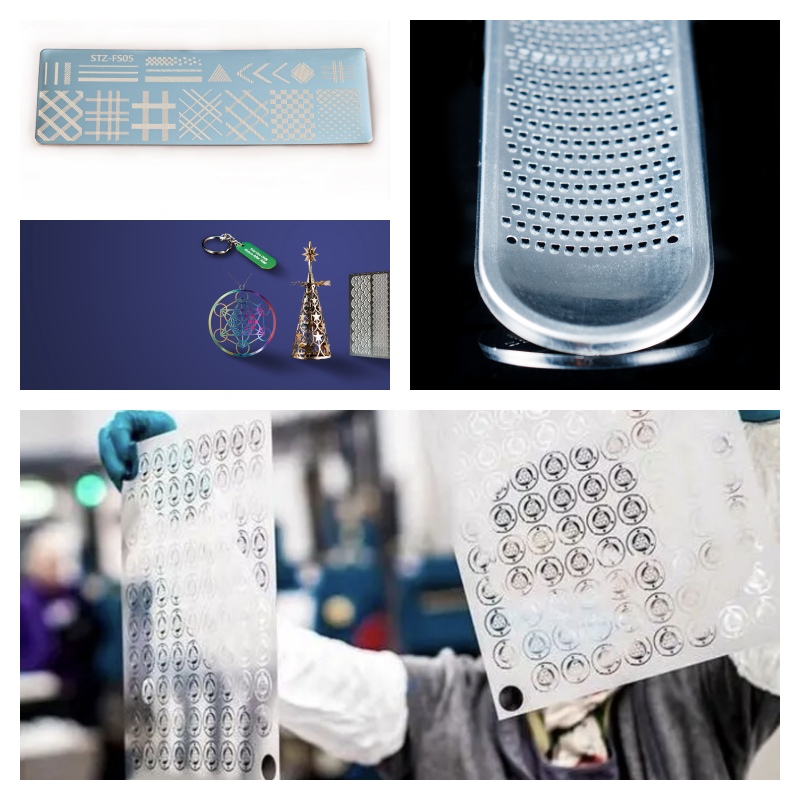
Through-holes are common in photo etching, but improper sizing and placement can cause problems. If a hole is too small relative to material thickness, it may fail to etch through completely, leaving a dimple or closed bottom. Conversely, holes that are too large can lose shape due to excessive undercut. The aspect ratio (hole diameter to material thickness) is critical; for most materials, a minimum aspect ratio of 1:1 is required to guarantee a clean through-hole. For example, in 0.3 mm thick stainless steel, the minimum hole diameter should be 0.3 mm. However, for better process stability, a 1.5:1 ratio is recommended. Additionally, the spacing between holes and edges should be at least the material thickness to prevent merging. Designers often overlook the fact that holes with tight tolerances need to be positioned away from other features to avoid distortion. DRAGON ETCHING uses precision phototools and double-sided etching to improve hole accuracy. For slots, the same principles apply: slot width should be at least 1.2 times thickness, and length-to-width ratios up to 50:1 are achievable. The company's engineers frequently suggest adding a small relief radius at slot ends to reduce stress. By following these guidelines, clients can avoid scrap and rework.
Pitfall 5: Inconsistent Texture or Marking Depth
Many photo etched parts feature surface textures, logos, or alphanumeric markings for branding or identification. A common pitfall is designing these features with insufficient depth contrast or with narrow lines that get lost during etching. The depth of etching is influenced by the resist pattern and etch time; fine lines may etch shallower than broad areas due to differences in etch rate. To ensure legibility, markings should have a line width at least 0.15 mm and a depth of at least 0.05 mm for visibility. However, if the depth is too great, it may weaken the part. DRAGON ETCHING recommends a depth of 10-20% of material thickness for durable markings. Another issue is the variability in etching across large areas; the company's controlled electrolyte flow and temperature uniformity minimize depth variation. For textured surfaces (e.g., matte finishes for grip), a periodic pattern of dots or lines works best. DRAGON ETCHING's advanced photoresist technology allows for high-resolution imaging, down to 0.01 mm line width for critical applications. The company also offers post-etching surface treatments if needed. To avoid shallow or uneven markings, provide clear specifications for depth and tolerance, and request a sample etch before full production.
Pitfall 6: Neglecting the Role of Grain Direction and Material Anisotropy
Metal sheets have a grain direction from rolling, which can affect etching uniformity. In some materials, the etch rate is slightly different along vs. across the grain, leading to oval holes or inconsistent feature dimensions. This is particularly noticeable in thicker sheets or alloys with large grain structures. Designers should specify the desired grain orientation relative to critical features. For example, long slots aligned with the grain may have straighter walls than those perpendicular to it. DRAGON ETCHING’s purchasing team selects materials with consistent grain size, and the company’s process parameters are adjusted to minimize anisotropic effects. When designing parts with multiple holes, consider staggering them to avoid alignment with rolling lines. If the application is sensitive to anisotropy (e.g., springs or diaphragms), DRAGON ETCHING can source special fine-grain materials or use stress-relief annealing prior to etching. Communicating these requirements early helps ensure predictable outcomes.
Pitfall 7: Overlooking Registration and Multi-Step Etching Tolerances
For parts that require etching on both sides with precise alignment (e.g., complex stencils or microfluidic devices), registration errors can cause misalignment between top and bottom features. This is a common pitfall when using separate phototools for each side. DRAGON ETCHING uses double-sided exposure with alignment systems that achieve better than ±0.025 mm registration. However, designers must provide clear fiducial marks and reference points. Another issue arises when parts need sequential etching steps (e.g., deep etching followed by shallow surface detailing). The resist must be able to withstand the first etch while protecting areas for the second. A mistake is to assume the first etch residue can be easily removed. DRAGON ETCHING employs multiple resist layers and controlled stripping to maintain precision. The company recommends limiting the number of etching steps to two or three for highest accuracy. For multi-step designs, consult with DRAGON ETCHING’s process engineers to verify compatibility and develop a robust etching sequence.

Pitfall 8: Using Inappropriate Material Selection for the Etching Process
Not all metals etch equally well. Some alloys (e.g., certain stainless steels with high sulfur content) can produce rough surfaces or pitting. Others, like beryllium copper, require special handling. A common mistake is to select a material based on final properties without considering its etchability. For instance, titanium alloys are difficult to etch without specialized acids, leading to high costs. DRAGON ETCHING maintains a list of preferred materials that offer a good balance of etch quality and mechanical properties, including stainless steels (304, 316, 17-7PH), copper alloys (C110, C17200), nickel alloys (Ni200, Hastelloy), and aluminum (6061, 7075). The company provides etching guidelines for each. Designers should provide full material specifications, including temper and hardness, as these affect etch rate and undercut. If a non-standard material is required, DRAGON ETCHING can conduct trial etches to characterize its behavior. The company’s material library and experience enable quick identification of potential issues.
Pitfall 9: Ignoring Post-Etching Processes in Design
Photo etching is often just one step in a manufacturing sequence. Parts may need deburring, stress relieving, flatness correction, or surface finishing. A common pitfall is designing features that become fragile after etching and cannot withstand downstream handling. For example, thin webs (narrow strips of metal) can warp or break during tumbling. Designers should ensure that minimum web widths are adequate: at least 1.5 times material thickness for unsupported sections. DRAGON ETCHING offers a range of post-etching services, including electropolishing, passivation, and heat treatment, and can advise on design modifications to facilitate these steps. For instance, adding small tabs or alignment holes can help with fixtureing during coating. The company’s integrated approach—from design review to final inspection—ensures that parts are optimized for the entire lifecycle.
Pitfall 10: Insufficient Design Communication and Lack of Prototypes
Finally, the most common pitfall is failing to communicate critical design intent or skipping prototype testing. Photo etching tools (phototools) can be expensive, and errors caught after tooling can be costly. DRAGON ETCHING strongly recommends submitting a complete design package with dimensional tolerances, edge condition requirements, and material specifications. The company provides a design rule checklist on its website. Additionally, ordering prototype quantities—often just a few sheets—allows designers to verify form, fit, and function before committing to mass production. For example, a medical device manufacturer avoided a recall by discovering through prototyping that the etch factor caused a critical hole to be oversize. DRAGON ETCHING’s prototype service has a typical turnaround of 5–7 business days, enabling rapid iteration. The company’s engineers are available for design reviews and can suggest improvements that reduce cost while maintaining performance. By fostering open communication and leveraging DRAGON ETCHING’s expertise, clients can turn a potential pitfall into a competitive advantage.
Conclusion: Partner with DRAGON ETCHING for Flawless Photo Etching
Avoiding common design pitfalls in photo etching requires a combination of technical knowledge, experience, and collaboration with a trusted manufacturing partner. DRAGON ETCHING TECHNOLOGY., LIMITED (DRAGON ETCHING) has built a reputation for excellence by helping clients navigate these challenges. With expertise across industries such as electronics, medical, automotive, and optics, the company provides end-to-end support from design for manufacturability (DFM) feedback to full-scale production. Its advanced facilities, rigorous quality control, and responsive service ensure that every component meets the highest standards. By following the guidelines in this article and engaging DRAGON ETCHING early in the design process, engineers and designers can avoid costly mistakes, reduce time-to-market, and achieve superior part quality. Whether it’s a simple shim or a complex multi-level component, DRAGON ETCHING is the partner of choice for precision photo etching.
For more information on design rules, material selection, or to request a quote, visit the DRAGON ETCHING website or contact their technical team. With DRAGON ETCHING, you can etch with confidence.