
Metal Etching Manufacturer Process Overview from Surface Preparation to Stripping
This article provides a comprehensive overview of the metal etching process from surface preparation to stripping, highlighting the expertise of DRAGON ETCHING TECHNOLOGY., LIMITED. The process begins with surface preparation, where metal sheets are meticulously cleaned and treated to ensure proper photoresist adhesion. Next, lamination applies a light-sensitive polymer film, which is then exposed to UV light through a photomask to transfer the desired pattern. Development removes unexposed resist, leaving a protective mask. Etching uses chemical solutions to selectively dissolve unprotected metal, with precise control over temperature and concentration to achieve tight tolerances. Finally, stripping removes the hardened resist to reveal the finished part. Quality control is integrated throughout, ensuring dimensional accuracy and defect-free surfaces. DRAGON ETCHING serves diverse industries including electronics, automotive, medical, and optics, offering burr-free, stress-free components with fast turnaround and no tooling costs. Their commitment to precision and innovation makes them a leader in the chemical etching industry.
Metal etching is a precise manufacturing technique used to create complex metal parts with tight tolerances. The process involves using chemical solutions to selectively remove material from a metal sheet, leaving behind the desired pattern. This article provides a comprehensive overview of the metal etching process, from surface preparation to final stripping, with insights from industry leader DRAGON ETCHING TECHNOLOGY., LIMITED.
Introduction to Metal Etching
Metal etching, also known as chemical etching or photochemical machining, is a subtractive manufacturing process that uses chemicals to etch away metal. It is ideal for producing intricate designs, thin parts, and components with burr-free edges. DRAGON ETCHING TECHNOLOGY., LIMITED has been at the forefront of this technology, offering customized solutions for industries such as Electronics and Semiconductor, Optics & Filtration, Automotive & Industrial, Medical & Consumer Electronics, and Cultural and Customized Gift Applications.
undefined
The Metal Etching Process Step by Step
1. Surface Preparation
Surface preparation is critical for ensuring proper adhesion of the photoresist and achieving high-quality etch results. The metal sheet is first cleaned to remove any oils, dirt, or oxides. Common cleaning methods include solvent wiping, alkaline cleaning, and acid pickling. At DRAGON ETCHING, rigorous cleaning protocols are followed to ensure a pristine surface, which is essential for consistent etching.
After cleaning, the metal is typically dried and sometimes treated with adhesion promoters. The surface must be perfectly smooth and free of contaminants to avoid defects. This step significantly impacts the final quality of the etched part.
| Step | Purpose | Common Methods |
|---|---|---|
| Degreasing | Remove organic residues | Solvent spray, alkaline bath |
| Descaling | Remove oxide layers | Acid pickle (HCl, H2SO4) |
| Rinsing | Remove residual chemicals | Deionized water rinse |
| Drying | Prevent water spots | Hot air blow, oven drying |
2. Lamination
Once the surface is prepared, a photoresist film is laminated onto the metal sheet. Photoresist is a light-sensitive polymer that will later be patterned. The lamination process requires precise temperature and pressure to ensure uniform adhesion without bubbles or wrinkles. DRAGON ETCHING uses advanced laminating equipment to achieve consistent resist thickness across large panels.
Two types of photoresist are commonly used: dry film and liquid resist. Dry film is widely preferred for its ease of handling and uniformity. The lamination step is performed in a cleanroom environment to prevent contamination.
3. Exposure
Exposure is the step where the desired pattern is transferred onto the photoresist. A photomask containing the design is placed over the resist-coated metal, and ultraviolet (UV) light is applied. The UV light polymerizes (hardens) the exposed areas of the photoresist, making them resistant to chemical etching. Unexposed areas remain soft and will be removed during development.
Precision in exposure is crucial. DRAGON ETCHING employs high-resolution photomasks and advanced exposure units to achieve fine features with line widths as small as a few microns. The exposure time and intensity are carefully controlled to ensure complete cross-linking of the resist.
4. Development
After exposure, the metal sheet is passed through a developer solution that removes the unexposed (soft) photoresist. This leaves behind a hardened resist pattern that exactly matches the mask design. The developer is typically a weak alkaline solution. The metal is then rinsed with deionized water to stop the development process.
The resulting resist pattern acts as a protective layer for the metal underneath. Any imperfections in the development will directly affect the etch quality, so this step is closely monitored using microscopic inspection.
5. Etching
Etching is the core of the process. The metal sheet is exposed to an etchant solution that dissolves the unprotected metal. Common etchants include ferric chloride for stainless steel and copper, and acidic solutions for aluminum and other alloys. The etchant is typically sprayed or the metal is immersed in a bath. Temperature, concentration, and agitation are precisely controlled to achieve uniform etch rates.
DRAGON ETCHING specializes in both batch and continuous etching systems. Their state-of-the-art facilities allow for high-volume production while maintaining tight tolerances. The etching process proceeds until the desired depth is achieved. For through-hole etching, the process continues until the metal is completely removed in open areas.
The table below shows typical etch rates for common metals at DRAGON ETCHING:
| Metal | Etchant | Etch Rate (mm/min) | Temperature (°C) |
|---|---|---|---|
| Stainless Steel | Ferric Chloride | 0.025 | 50 |
| Copper | Ferric Chloride | 0.050 | 40 |
| Aluminum | NaOH solution | 0.030 | 60 |
6. Stripping
After etching, the remaining photoresist must be removed. Stripping involves exposing the metal to a chemical solution that dissolves the hardened resist without attacking the metal. Common strippers include strong alkaline solutions or solvents. The stripped part is then thoroughly rinsed and dried.
Proper stripping is essential to reveal the clean etched features. Incomplete stripping can leave residues that affect downstream processes. DRAGON ETCHING uses automated stripping lines that ensure complete removal, followed by quality checks using optical microscopy.
Post-Etching Operations
Once stripped, the metal parts may undergo additional processes such as annealing, deburring (though chemical etching inherently produces burr-free edges), passivation, or inspection. DRAGON ETCHING offers a full range of post-etching services to meet customer specifications.
Quality Control
Throughout the entire process, quality control is paramount. DRAGON ETCHING maintains rigorous standards, including dimensional inspection, surface roughness measurement, and visual inspection. Their commitment to quality ensures that each component meets the highest standards of accuracy and reliability. From prototype development to large-scale production, they work closely with clients to transform complex designs into precise, functional metal parts.
Incoming material inspection: Check metal thickness, flatness, and cleanliness.
In-process monitoring: Resist thickness, exposure uniformity, etch rate, and bath chemistry.
Final inspection: Dimensional accuracy, edge quality, and surface finish.
Applications of Metal Etching
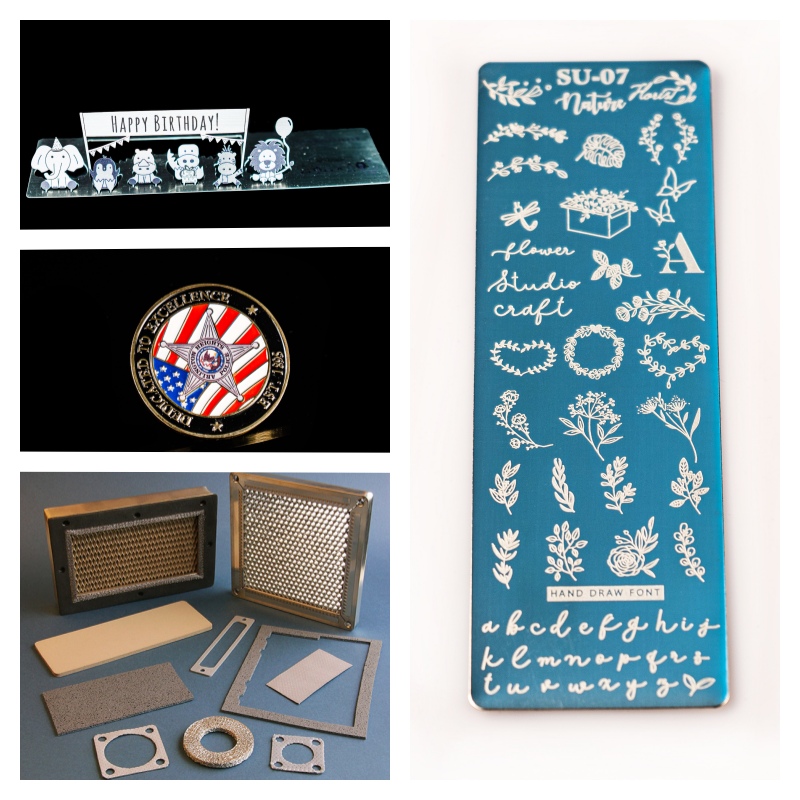
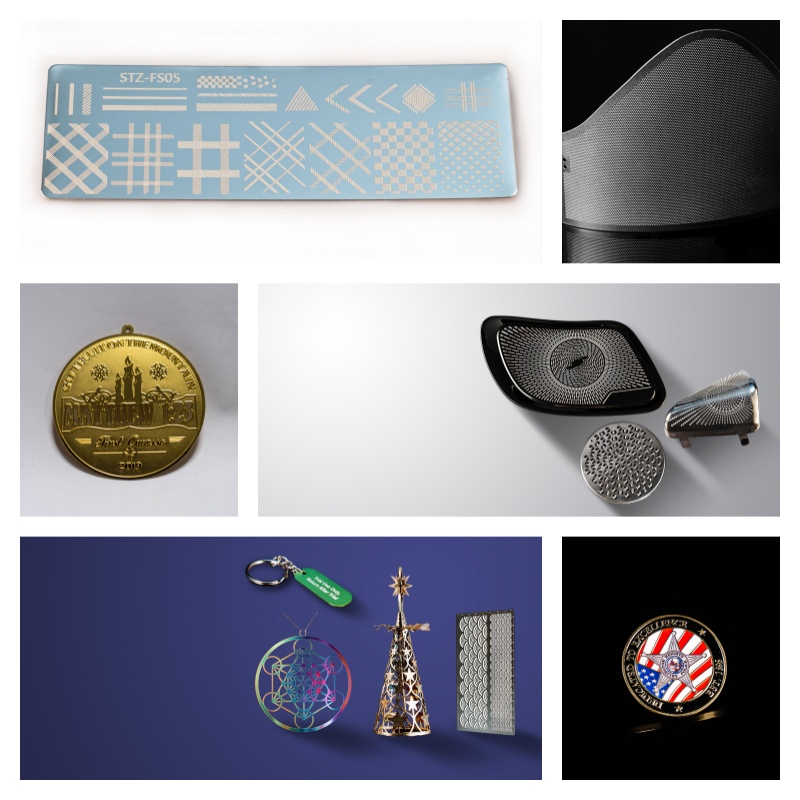
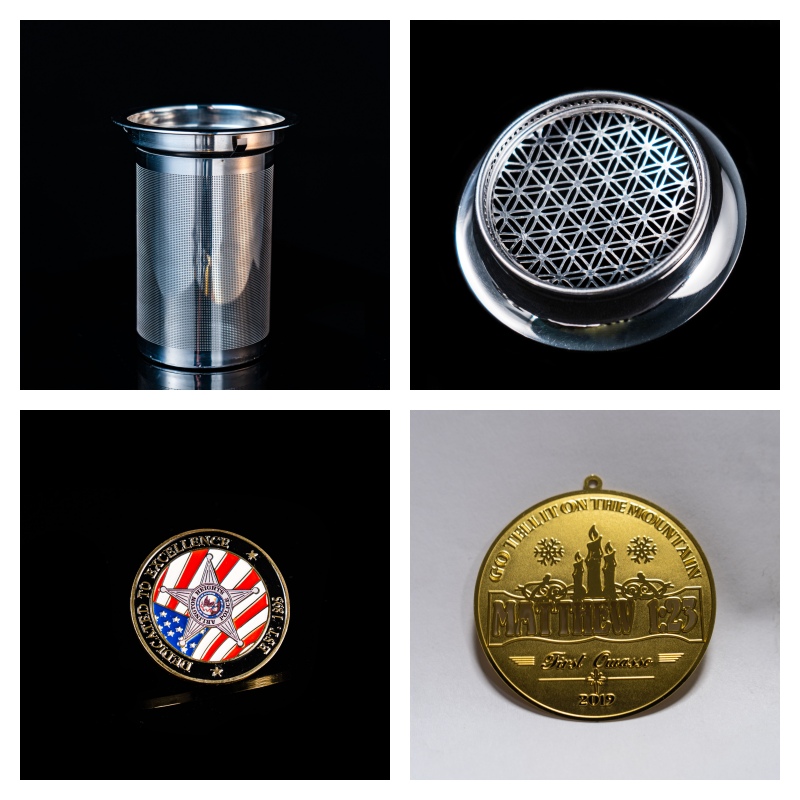
Metal etching is used across diverse industries. DRAGON ETCHING serves Electronics and Semiconductor (lead frames, EMI shields), Optics & Filtration (shutters, encoder disks), Automotive & Industrial (fuel cell plates, gaskets), Medical & Consumer Electronics (surgical instruments, phone components), and Cultural and Customized Gift Applications (nameplates, decorative pieces).
The versatility of chemical etching makes it ideal for:
Complex geometries that are difficult to stamp or laser cut.
Thin materials (down to 0.01 mm) without deformation.
High-volume production with consistent quality.
Burr-free and stress-free parts.
Advantages of Chemical Etching
Compared to traditional machining methods, chemical etching offers several advantages:
No tooling costs: Changes in design require only a new mask.
Fast turnaround: Prototypes can be produced in days.
Excellent edge quality: No burrs or mechanical stress.
Ability to etch multiple parts in a single panel.
DRAGON ETCHING leverages these advantages to provide professional solutions that exceed client expectations and drive industry advancement.
Conclusion
From surface preparation to stripping, each step in the metal etching process demands precision and control. DRAGON ETCHING TECHNOLOGY., LIMITED combines years of experience, advanced technology, and responsive service to deliver high-quality etched components. Whether for medical devices, automotive parts, or consumer electronics, their expertise ensures that every part meets rigorous standards. By understanding the process overview outlined in this article, engineers and designers can better appreciate the capabilities of metal etching and how DRAGON ETCHING can bring their designs to life.